China’s Huge Dog Stuffed Animal market is expanding beyond children’s bedrooms. These oversized plush products now appear in retail displays, hotel lobbies, themed rooms, and social-media campaigns. Their appeal is immediate: soft fur, oversized paws, and a body large enough for a child to hug.
Recent industry reports support this wider opportunity. Grand View Research estimates that the global stuffed and plush toys market will continue growing through the decade, supported by gifting, character merchandise, and online retail. IMARC also identifies e-commerce and product customization as important growth drivers. However, these reports rarely separate giant dog designs from ordinary plush toys. That gap matters when comparing Chinese suppliers.
Dr. Amanda Gummer, founder of The Good Play Guide, has stated, “A good toy should be fun, safe and developmentally appropriate.” Her principle is useful here. A reliable supplier must show more than attractive factory photographs. Buyers should examine fabric density, seam strength, stuffing recovery, odor control, washable construction, packaging size, and documented quality procedures. For commercial buyers, EN 71, ASTM F963, or equivalent testing may also require careful verification for the destination market.
This guide reviews China’s top ten Huge Dog Stuffed Animal suppliers through a practical lens. It considers manufacturing experience, customization, sampling, communication, production capacity, and export reliability. Rankings are never perfect. A supplier may excel at a two-meter plush dog but struggle with small trial orders. That uncomfortable detail deserves attention. Fancy catalogs can hide ordinary production limits.
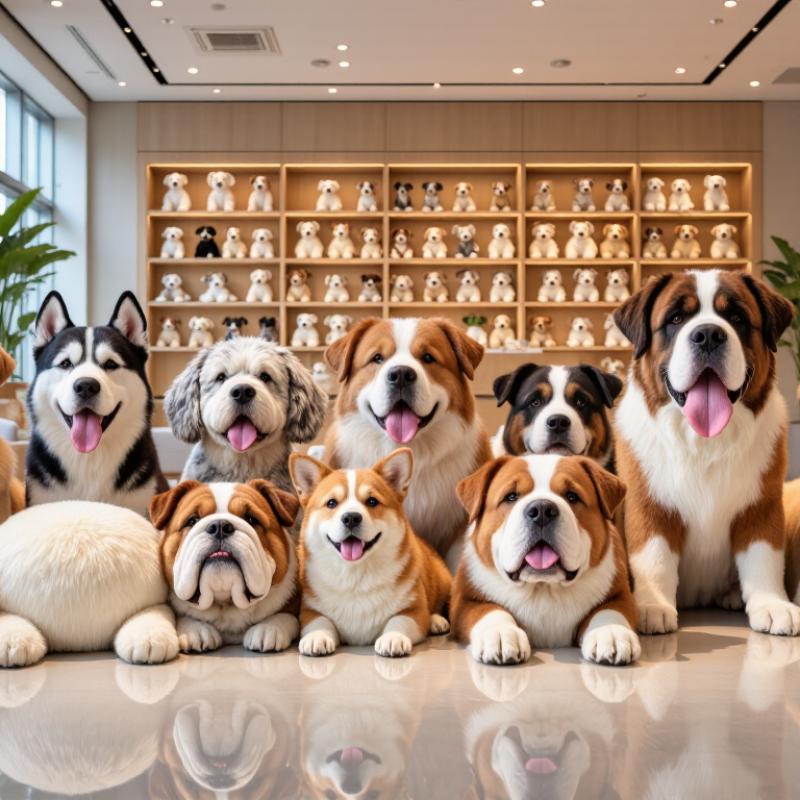
A standout Chinese huge dog stuffed animal supplier proves quality before discussing price. Grand View Research valued the global stuffed toys market at USD 11.98 billion in 2022. It forecasts an 8.5% annual growth rate from 2023 to 2030. This growth attracts many factories, but scale alone means little. Buyers should request stitching photos, filling specifications, fabric composition, and recent inspection records. Details matter.
Reliable suppliers explain how a 60-centimeter plush dog keeps its shape after repeated handling. They should test seam strength, colorfastness, stuffing recovery, and small detachable parts. Compliance with ISO 8124 or ASTM F963 requirements shows stronger technical discipline. A clear batch-traceability system also matters when defects appear. Grand View Research identifies online distribution as an important growth channel, so suppliers need accurate product images, packaging data, and dependable export documentation.
Production flexibility separates capable suppliers from simple trading offices. Ask about minimum order quantities, prototype revisions, mold ownership, and lead-time changes during peak seasons. Circana reported that U.S. toy sales fell 8% in 2023, reaching approximately USD 28.6 billion. Demand can shift quickly. A supplier that shares realistic capacity data is more trustworthy than one promising unlimited output. I would still inspect the factory independently, because polished samples can hide weak production control. One missed seam can damage customer confidence.
Selecting China’s top ten huge dog stuffed animal suppliers requires more than browsing polished factory photos. We compare verified production experience, material documentation, sampling quality, and communication speed. A reliable supplier should explain fabric density, filling recovery, seam construction, and cleaning instructions clearly. We request a physical sample, then inspect its paws, ears, zipper area, and inner stitching. These small points reveal workmanship. Factory audits, export records, and third-party test reports add useful evidence, but paperwork alone cannot prove consistency. One sample may look excellent while the second feels flatter. That happened in a real comparison, and it changed our scoring.
Our comparison uses weighted criteria: product quality, customization ability, capacity, lead time, pricing transparency, packaging, and after-sales response. Quality receives the strongest weight because oversized toys need stable filling and reinforced seams. Capacity matters when a supplier must repeat the same shape across hundreds of pieces. We also check whether measurements remain accurate after compression packing. Some suppliers promise fast delivery, yet their timelines exclude sampling or material approval. That is an easy detail to miss. We record questions, replies, revisions, and final sample differences in one review sheet. This creates a more dependable ranking, although human judgment still affects the result.
Tips: Ask for close-up seam photos and a sample made with final materials. Confirm carton dimensions before freight calculations. Request a written production schedule with inspection points. Do not select the lowest quote automatically; unusually cheap filling or thin fabric may reduce comfort and durability. Check children’s product safety documentation for the target market, and verify claims independently. Be willing to revise the list when new evidence appears. Good rankings should remain open to correction.
This comparison uses a transparent 100-point screening framework for large dog stuffed-animal manufacturers in China. Supplier identities and brand information are intentionally omitted; rankings should be confirmed through current documents, samples, factory audits, and commercial quotations.
| Evaluation Dimension | Weight | What Is Compared | Minimum Evidence Required | Higher-Score Indicator |
|---|---|---|---|---|
| Product Safety and Testing | 20% | Age grading, small-part risks, seams, stuffing retention, flammability, and mechanical safety. | Recent third-party test reports matched to the exact product, materials, and target market. | Complete, product-specific reports |
| Material and Chemical Compliance | 15% | Fabric, dyes, thread, filling, plastics, metal parts, and restricted substances. | Material declarations and laboratory testing aligned with the destination market. | Traceable compliant materials |
| Manufacturing Quality System | 15% | Incoming inspection, in-process checks, final inspection, defect handling, and corrective action. | Quality manual, inspection records, sample approval process, and audit evidence. | Documented, repeatable controls |
| Customization Capability | 10% | Pattern development, size scaling, embroidery, printing, labels, packaging, and prototype revisions. | Approved pre-production sample and clear revision history. | Reliable sample-to-production consistency |
| Production Capacity | 10% | Available sewing lines, stuffing equipment, peak-season planning, and capacity for oversized products. | Production plan, facility overview, and capacity confirmation for the required order quantity. | Capacity backed by records |
| Minimum Order Quantity | 8% | MOQ for prototypes, standard production, custom fabric, custom packaging, and size variations. | Written quotation showing MOQ by product and customization level. | Flexible MOQ with transparent charges |
| Lead Time and Delivery Reliability | 7% | Sample lead time, production lead time, inspection time, and historical on-time performance. | Detailed production schedule and shipment records or customer references. | Predictable documented schedules |
| Factory Transparency and Auditability | 5% | Legal entity verification, manufacturing location, subcontracting disclosure, and audit access. | Business registration information, factory address, and permission for an independent audit. | Verifiable manufacturing footprint |
| Packaging and Logistics Support | 5% | Compression packaging, carton design, dimensional-weight impact, labeling, and export documentation. | Packing specification, carton measurements, loading plan, and shipping documents. | Optimized for oversized goods |
| Communication and After-Sales Support | 5% | Response time, engineering communication, claim handling, replacement policy, and corrective actions. | Named contact, service terms, escalation process, and written defect-resolution policy. | Fast, accountable communication |
| Comparison Dimension | Common Screening Range or Requirement | Why It Matters | How to Verify |
|---|---|---|---|
| Finished Product Size | Approximately 80–200 cm in length, depending on the design and measurement method. | Size affects pattern engineering, stuffing density, carton dimensions, freight cost, and storage. | Approve a dimensional specification sheet and measure the final sample. |
| Outer Fabric | Polyester plush, short-pile plush, faux fur, or other specified textile with colorfastness requirements. | Fabric affects softness, appearance, durability, shedding, and cleaning performance. | Review fabric composition, GSM, color standard, and laboratory test results. |
| Filling Material | Typically polyester fiberfill or another declared textile filling suitable for the intended use. | Filling influences firmness, recovery, weight, shape retention, and seam stress. | Check material declaration, filling distribution, and compression-recovery sample. |
| Safety-Critical Attachments | Embroidered or securely attached features are generally preferred for products intended for children. | Eyes, noses, buttons, plastic parts, and other attachments can create small-part or pull-test risks. | Use the applicable destination-market safety standard and perform product-specific testing. |
| Seam and Stitching Quality | Consistent stitch density, reinforced stress points, no exposed sharp components, and no accessible loose filling. | Oversized plush products place greater stress on seams during handling and use. | Conduct visual inspection, seam-strength checks, and repeated handling tests. |
| Compression Packaging | Compression may reduce shipping volume but must not permanently deform the product or damage decoration. | Large plush items can incur substantial dimensional-weight charges. | Approve compression duration, carton size, recovery time, and post-opening appearance. |
| Prototype Process | Pattern sample, material sample, appearance sample, and pre-production sample before mass production. | Large products magnify proportion, stuffing, and construction errors. | Require signed sample approval and a controlled specification package. |
| Regulatory Documentation | Destination-market documentation should match the exact SKU, materials, construction, and intended age group. | Generic or outdated reports may not demonstrate compliance for the finished product. | Verify report number, laboratory, test date, product description, and applicable standard. |
| Order Planning | Quotation should state MOQ, sample fee, tooling or pattern charges, production lead time, and payment terms. | Clear commercial terms reduce unexpected costs and schedule disputes. | Compare written quotations using the same specification and delivery terms. |
| Final Inspection | Inspection should cover appearance, dimensions, workmanship, labeling, packaging, quantity, and carton condition. | A final inspection helps identify defects before shipment and supports consistent batch quality. | Use an agreed inspection checklist and acceptance criteria. |
Reference framework: product-specific requirements should be checked against the regulations and voluntary standards applicable in the destination market, such as the U.S. Consumer Product Safety Improvement Act and relevant ASTM toy-safety requirements, or the applicable European Union toy-safety and chemical-compliance requirements. Certification and test obligations vary by product design, intended age group, materials, and sales destination.
China’s leading huge dog stuffed animal suppliers usually offer lying, sitting, and cartoon-style designs. Product choice matters more than a charming sample. A 120-centimeter dog may look impressive, but it can slump when filled unevenly. IMARC Group estimates the global stuffed toy market reached about USD 10.2 billion in 2023, with steady growth expected through 2032. That demand encourages suppliers to expand sizes from 30 centimeters to over 200 centimeters. Large versions need stronger seams, balanced filling, and reinforced belly panels.
Common materials include short-pile polyester plush, long-pile fabric, velour, and recycled polyester fill. PP cotton creates a softer shape, while foam may improve structure but changes washing requirements. Embroidered eyes are generally more suitable for oversized products than detachable plastic parts. Suppliers should provide material composition, colorfastness, seam-strength, and flammability test records. EN 71, ASTM F963, and ISO 8124 are useful reference standards for international purchasing, though requirements differ by destination.
Customization can include facial expressions, ear length, fur color, clothing, woven labels, gift boxes, and vacuum packaging. A practical supplier should confirm drawings before sampling and state the minimum order quantity clearly. Sampling often reveals uncomfortable surprises. The tail may twist, or the head may lean forward. One overlooked detail is carton compression; oversized plush toys can arrive permanently flattened. Experienced buyers should request unpacking photos, measurement tolerances, and third-party inspection records before production.
The chart compares commonly specified size ranges for major giant dog plush formats. Products are typically made with soft polyester fabric and filled with polyester or PP cotton fiber. Customization may include dog breed shape, color, embroidery, printed patterns, fabric selection, filling density, labels, packaging, and OEM dimensions.
A reliable factory should document material sources, production steps, and batch records. Inspectors should check polyester fabric, recycled filling, thread strength, and color consistency. Soft toys need secure eyes, noses, and decorative parts. Small pieces can create serious risks.
Common checks include flammability, migration of harmful substances, mechanical strength, and sharp-point inspection. Testing may reference EN 71, ASTM F963, or other applicable regulations. Ask for recent laboratory reports, not sample certificates from older orders.
A practical audit should also review needle-control procedures, metal detection, worker training, and warehouse cleanliness. Look closely.
Quality control works best at several stages. Inspectors can measure ear placement, body shape, seam allowance, and stuffing weight before packing. A large plush dog may look attractive but still fail after repeated pulling. Drop tests and wash tests reveal hidden weaknesses. Packaging should prevent moisture, dust, and compression damage during shipping.
Even careful teams miss defects occasionally. That weakness deserves honest discussion, not polished promises. Suppliers should provide corrective-action records and explain how they prevent repeat problems.
Buyers can request pre-production samples, mid-production inspections, and random final checks. Clear photos, signed specifications, and traceable batch numbers make quality decisions more reliable.
A reliable shortlist should compare more than catalog photos. Grand View Research reported steady growth in the global plush toy market, supported by online retail and personalized products. For huge dog stuffed animals, typical factory pricing ranges from $4 to $18 for 30–60 cm designs. Oversized 100–150 cm pieces may cost $28–$90, depending on filling, fabric, embroidery, and packaging. These are practical estimates, not fixed quotations.
Minimum orders commonly range from 100 to 500 pieces per design. Some workshops accept smaller trial orders, but unit prices increase sharply. Sample development usually takes 7–12 days. Production often requires 30–60 days after approval. Add 7–15 days for peak-season delays. It happens.
Export-ready suppliers should provide pre-production samples, material specifications, carton measurements, and inspection records. Their service should include commercial invoices, packing lists, certificates of origin, and support for common sea or air freight arrangements. UN Comtrade data continues to show China’s strong position in global toy exports, but export volume alone does not prove factory reliability. Buyers should request recent shipment evidence and verify production capacity through video audits or third-party inspections.
A practical test uses one detailed sample: floppy ears, reinforced seams, washable fabric, and evenly distributed filling. I would not trust the lowest quote without checking defect rates. That judgment can be expensive. Packaging also deserves attention, because a large stuffed animal can arrive compressed, wrinkled, or misshapen. Suppliers should explain recovery time and replacement policies before purchase.
We compare quality, customization, capacity, lead time, pricing, packaging, and after-sales support. Quality receives the strongest weight.
Photos hide weak stitching and uneven filling. Inspect the paws, ears, zipper area, belly panels, and inner seams.
Suppliers often use short-pile plush, long-pile fabric, velour, polyester fill, or recycled polyester. Each material changes softness and washing needs.
Request material composition, colorfastness, seam-strength, flammability, and destination-market safety records. Verify documents independently.
Customization may include fur color, facial expression, ear length, clothing, labels, gift boxes, and vacuum packaging.
A large dog may slump, lean forward, or arrive permanently flattened. Uneven filling is common enough to check carefully.
Smaller designs may cost $4–$18. Larger designs may cost $28–$90. Minimum orders often range from 100 to 500 pieces.
Sampling often takes 7–12 days. Production commonly takes 30–60 days after approval. Peak seasons may add 7–15 days.
Ask for invoices, packing lists, origin documents, carton measurements, inspection records, and recent shipment evidence.
No. Documents help, but judgment still matters. One sample may look excellent while another feels flatter. Rankings need correction.
China has become a major source of Huge Dog Stuffed Animal products, offering a wide range of sizes, materials, designs, and customization options for retailers, promotional campaigns, and gift businesses. This overview explains what distinguishes a reliable supplier, including production experience, design capability, communication, responsiveness, and the ability to deliver consistent quality. It also introduces a practical comparison approach based on product variety, manufacturing capacity, customization support, and export experience.
The article further examines safety-focused manufacturing standards, material selection, stitching quality, filling, inspections, and testing procedures. Buyers can also learn how pricing is influenced by size, materials, order quantity, packaging, and customization, as well as how minimum order quantities, lead times, sample approval, logistics, and export documentation affect purchasing decisions. By reviewing these factors together, businesses can identify suitable suppliers and make informed choices for dependable, attractive, and market-ready products.

D King